
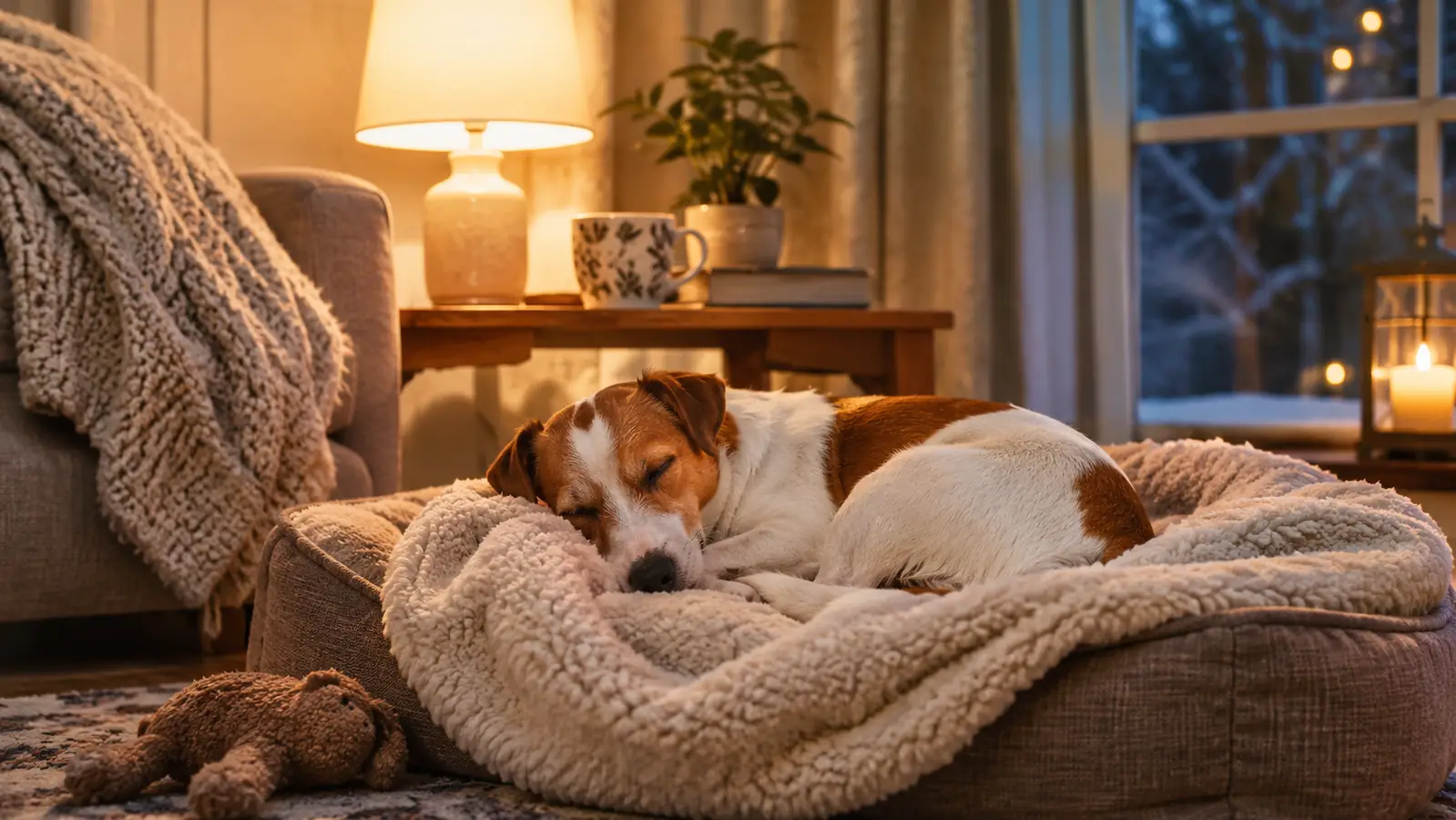
If your small dog is anything like my Pepper, you have watched her shiver under a thin blanket on a cold night and wished you had a way to warm her bed without buying another gadget. A 10-pound Miniature Pinscher with a short single coat does not hold heat well, and our Medford winters get down into the 20s at night. I tried extra bedding, a hot water bottle wrapped in a towel, even moving her bed next to the heat vent. The hot water bottle cooled off by midnight. The vent dried her out. What finally worked was simpler than all of it: a Bedsure self-warming blanket folded into a nest that traps her own body heat, with no cord and no electricity at all.
I built the whole setup in about ten minutes one evening, using the Bedsure self-warming blanket and things I already had around the house. The blanket is 25 by 35 inches, which is the small size, and it is lined with warm Sherpa on one side and flannel fleece on the other. That double-sided design is the whole idea. The Sherpa side holds heat close to her body, and the fleece side gives her something soft to burrow against. Because it reflects her own warmth back at her, it works all night long without ever getting too hot.
Start With the Blanket That Does the Work
The Bedsure self-warming blanket in the 25 by 35 inch size is the one I used for Pepper's bed. It reflects her body heat back at her, needs no electricity, and machine washes like a regular throw. Check today's price on Amazon and see if it fits your dog's bed.
Amazon Check Today's Price on Amazon →Step 1: Measure Your Dog's Bed Before You Fold Anything
The most important step has nothing to do with the blanket itself. Measure the sleeping surface of your dog's bed, not the outside edge. Pepper's crate-side bed is about 18 by 24 inches of actual lying space, so the 25 by 35 inch Bedsure blanket gives me plenty of material to fold and tuck. If your dog's bed is bigger, you can still make this work, you will just need to fold the blanket into a thicker pad rather than laying it flat.
For a small or toy dog, you want the finished nest to be a little smaller than the bed itself. That leaves a border of the bed's own fabric around the edges, which gives your dog a place to put her head if she gets too warm. Pepper likes to sleep with her chin on the bare edge of her bed and her body on the blanket. If I covered the whole bed, she would push the blanket around until she made her own border anyway. Pepper is about 14 inches from the base of her neck to the base of her tail, so the 25 by 35 inch blanket is roughly twice her length. That sounds like too much blanket, but once it is folded into a nest it is just right. A blanket that is barely bigger than your dog will not have enough material to make a rim, and the rim is what keeps the warmth from escaping.
Write down the measurements even if you think you will remember them. I did not, and I refolded the blanket three times before I got the size right. A measuring tape takes thirty seconds and saves you a lot of fussing.
Step 2: Fold the Blanket Into a Nest Shape
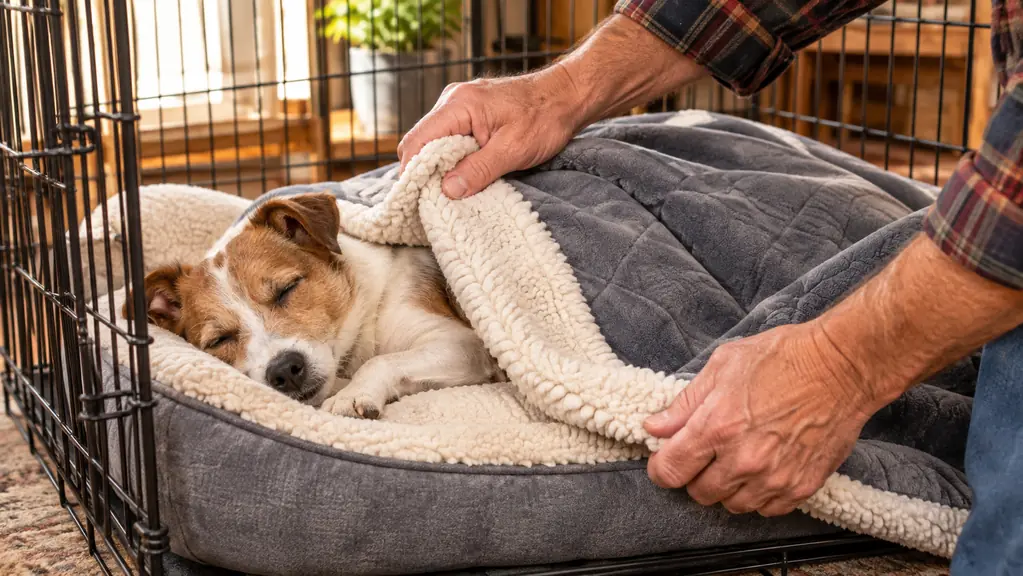
Lay the Bedsure blanket flat with the Sherpa side facing up. Fold it in half lengthwise so it measures roughly 25 by 17.5 inches, then fold it in half again the other way to get a thick pad about 12.5 by 17.5 inches. That gives you four layers of warmth under your dog. For a smaller bed, fold it into thirds instead. The exact size matters less than the thickness, because the trapped air between the layers is what holds her body heat. I started with a single layer laid flat, and Pepper lay on top of it shivering just as much as she had before. The problem was that a flat sheet does not trap anything. The folded pad is what makes the difference, because each layer holds a little pocket of warm air next to her body. If your dog is closer to 15 pounds, add one more fold and see whether she stays put.
Once you have the pad folded, shape it into a shallow nest by tucking the corners under and pressing down in the middle. You want a slight dip in the center, just deep enough for a small dog to curl into, with a raised rim around the outside. The rim is not for decoration. It blocks drafts from the sides of the bed and gives your dog something to lean against while she sleeps. Pepper curls into a tight ball, so the rim comes up around her back and holds the warmth in.
Do not make the nest too deep. A 10-pound dog needs to be able to climb in and out easily, especially at night when she is sleepy. If the rim is too tall, she will just sleep on top of it instead of inside it, and then the whole point is lost.
Step 3: Add a Thin Layer Underneath for the Waterproof Protection
Here is the part I learned the hard way. The Bedsure blanket has a central waterproof membrane, which means it stops liquid from leaking through to whatever is underneath. That is a wonderful feature for a dog bed, but it also means the blanket itself can feel a little less breathable if your dog lies directly on it for hours. So I put a thin cotton sheet or an old t-shirt between the nest and my dog. The cotton touches her fur, the Sherpa holds the warmth, and the waterproof layer protects the bed underneath. The first night I skipped this layer and let Pepper lie directly on the Sherpa. She was warm enough, but by morning her fur felt a little damp where she had been pressed against the waterproof membrane for eight hours. The cotton layer fixed that completely. Now the setup breathes the way a normal bed does, and the waterproof protection is still there underneath.
If you do not have a spare cotton sheet, a receiving blanket or a soft t-shirt works just as well. The layer does not need to be thick. It only needs to be breathable and washable. I use an old flannel shirt that I cut into a rough rectangle, and it has held up through a whole season of machine washing.
This layer also gives you an easy way to keep the whole setup clean. The Bedsure blanket is machine washable in cold water and can be dried on low, and so is the cotton layer. When one is in the wash, the other takes its place. Pepper has never had an accident on the bed, but older dogs and puppies might, and knowing the bed itself is protected is worth the extra two minutes of setup.

Step 4: Tuck the Blanket Around the Edges of the Bed
A loose blanket on top of a dog bed will end up on the floor by morning. Pepper burrows, and burrowing dogs push bedding around. So after I shape the nest, I tuck the edges of the Bedsure blanket under the sides of the bed's own cushion. If your bed has a removable cover, you can tuck the blanket between the cover and the cushion, which holds it in place even better. I tried leaving the blanket loose for the first two nights, and both mornings I found it bunched up in the corner of the crate with Pepper sleeping on the bare mat. Tucking the edges under the cushion took about a minute and solved the problem for good.
For a crate bed, tuck the blanket edges under the crate tray as well. That anchors the whole setup so your dog cannot drag it out during the night. Pepper figured out within a week that the tucked blanket was not going anywhere, and she stopped trying to rearrange it.
Leave the front edge slightly loose so your dog can get under the blanket if she wants to. Some nights Pepper sleeps on top of the nest with the Sherpa under her. Other nights she burrows completely underneath, with just her nose poking out. The loose front edge is what makes both options possible. If you tuck every edge down tight, you take away her choice, and she will spend ten minutes trying to fix it herself.
Step 5: Test It for a Few Nights and Adjust
The first night I set this up, Pepper inspected the nest, walked a circle in it, and then lay down with her chin on the rim. She did not burrow under until about an hour later, when the house had cooled down. That is normal. A self-warming blanket does not produce heat, it reflects the heat your dog's own body makes, so it takes a few minutes for the nest to feel noticeably warm. Give your dog a couple of nights to figure it out before you decide whether it works.
Check the setup in the middle of the night for the first few nights. I woke up once to find Pepper sleeping on the floor of the crate with the whole nest pushed to one side. She had gotten too warm and moved off the blanket. I folded it one layer thinner the next day, and after that she stayed put. Watch for the signs: if she lies on top of the blanket instead of inside it, the nest is too warm or too deep. If she keeps burrowing and shivering, add another layer or tuck the edges tighter. On the third night I checked at about 2 in the morning and she was curled in the middle of the nest with her nose tucked under the rim, breathing slow and even. That was the first night in weeks she had not woken me up by shuffling around. After that I stopped checking and just let her be.
Within a week, Pepper was going straight to her bed at night and staying there until morning. The Bedsure blanket does not replace a heated pad for a dog that needs actual heat, but for a healthy small dog that just needs help holding her own warmth, it has been the difference between a restless night and a solid one.
What Else Helps
A self-warming blanket works best when the rest of the room is doing its part. Keep the bed off the floor if you can, or put a folded rug or a piece of cardboard under it to block the cold that comes up through the floor. In our manufactured home, the floor gets genuinely cold in winter, and the bed on its own was not enough. The folded blanket nest plus a barrier underneath made a real difference. You can also move the bed a few inches away from exterior walls and windows on the coldest nights. And if your dog sleeps in a crate, leave the crate door open a crack so warm air from the room can circulate in. None of these things cost anything, and they all make the self-warming blanket work harder. On the coldest nights, when the thermometer outside read 19 degrees, I also draped a second throw over the top of the crate, leaving the front open. That kept the heat in without trapping Pepper inside.
The Bedsure blanket does not produce heat. It reflects the warmth your dog already makes, which is exactly why it cannot overheat her.
Give Your Small Dog a Warmer Night
The 25 by 35 inch Bedsure self-warming blanket is the one I used to build Pepper's bed warmer. It is waterproof, reversible, and machine washable, and it needs no electricity. Check today's price on Amazon to see if it fits your dog's bed.
Amazon Check Today's Price on Amazon →