
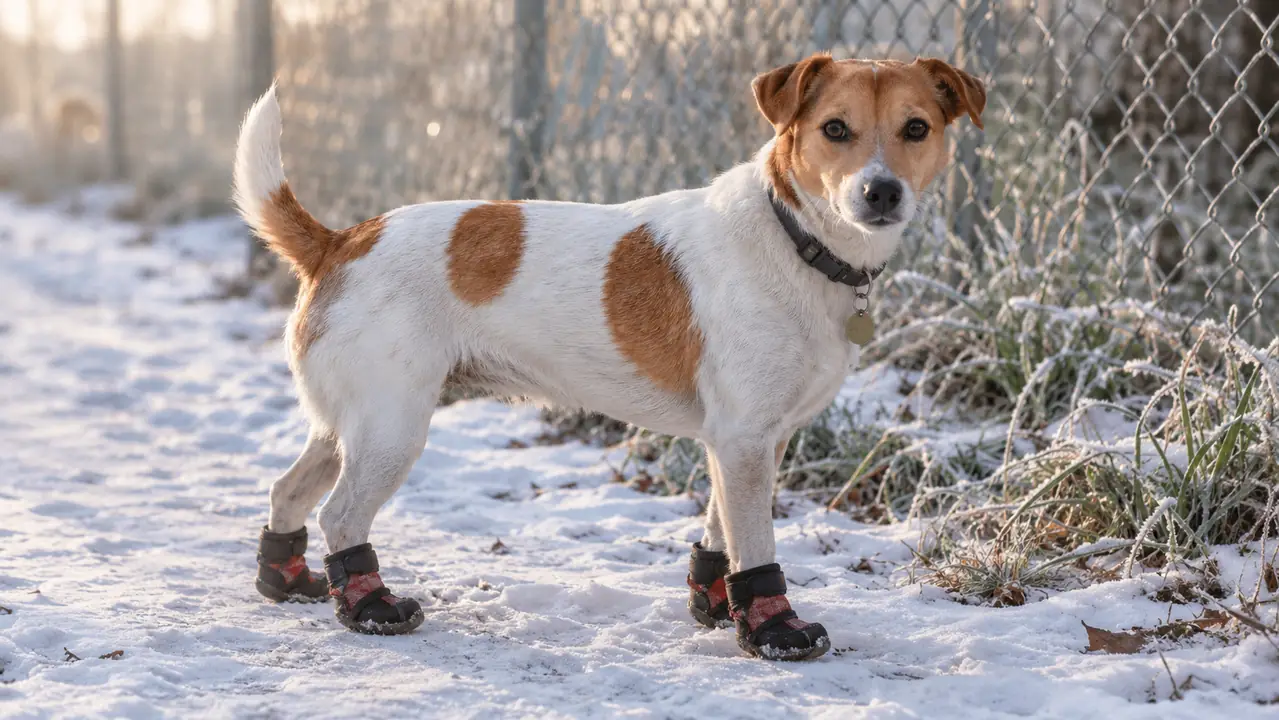
Last December, Pepper stepped off the porch onto the mobile-home loop and stopped dead. The county had salted the pavement that morning, and the ice underneath had turned into that gritty, sharp slush that sticks to a dog's paws and burns between the toes. She lifted one front paw, then the other, then sat down and refused to take another step. I carried her back to the porch, and that night I noticed her licking her pads. The next morning, she limped on the front left foot for the first few steps of our walk. That was the day I got out the cloth tape and started measuring her paws for boots.
I will tell you straight: I am not the kind of person who puts shoes on a dog. Pepper is a 7-year-old Miniature Pinscher, about 10 pounds, with a short single coat, a deep chest and legs like sticks. She starts shivering below about 45 degrees and hates wet grass, so she already owns a small wardrobe of coats and sweaters. But boots felt like a step too far. Then she limped for two days after a walk on salted pavement, and I changed my mind. The QUMY dog boots are what I landed on after a lot of measuring and second-guessing, and this is the honest version of how they worked out over a full winter of icy walks around the park and the mobile-home loop.
The Quick Verdict
Solid paw protection for icy, salted days once you get the sizing right. The smallest size still runs roomy on a toy dog, so measure the paw width first and plan for a week of practice indoors before you trust them on a real walk.
Amazon Check Today's Price →Paw protection that actually stays on, once you size it right
QUMY's set of four boots uses hook and loop straps and a slip-proof sole to handle ice, salt and rough ground. The catch is sizing, so measure the paw first and snug the straps tight.
Amazon Check Today's Price on Amazon →How I've Used These Boots
Pepper wears these QUMY boots only on the days that call for them: icy mornings, salted pavement, and the wet cold days when the loop is running with meltwater. That works out to two or three walks a week from December through February, about 15 to 20 minutes each. She does not wear them on dry days, and she does not wear them around the house. These are tools for a specific job, not an everyday shoe, and treating them that way is part of why they have lasted.
The first time I put them on, she walked like a wind-up toy that needed winding. High steps, long pauses, one boot shaking in the air like she was trying to flick it off. I kept the sessions short, five minutes in the living room, then a trip to the porch, then back inside. I gave her a treat every time she took a few normal steps. By the end of the first week she was walking normally, and by the second week she would stand still and let me do the straps. That practice week matters more than people expect. If you put these on a dog for the first time and head straight out the door, you will both be frustrated and you will both blame the boots.
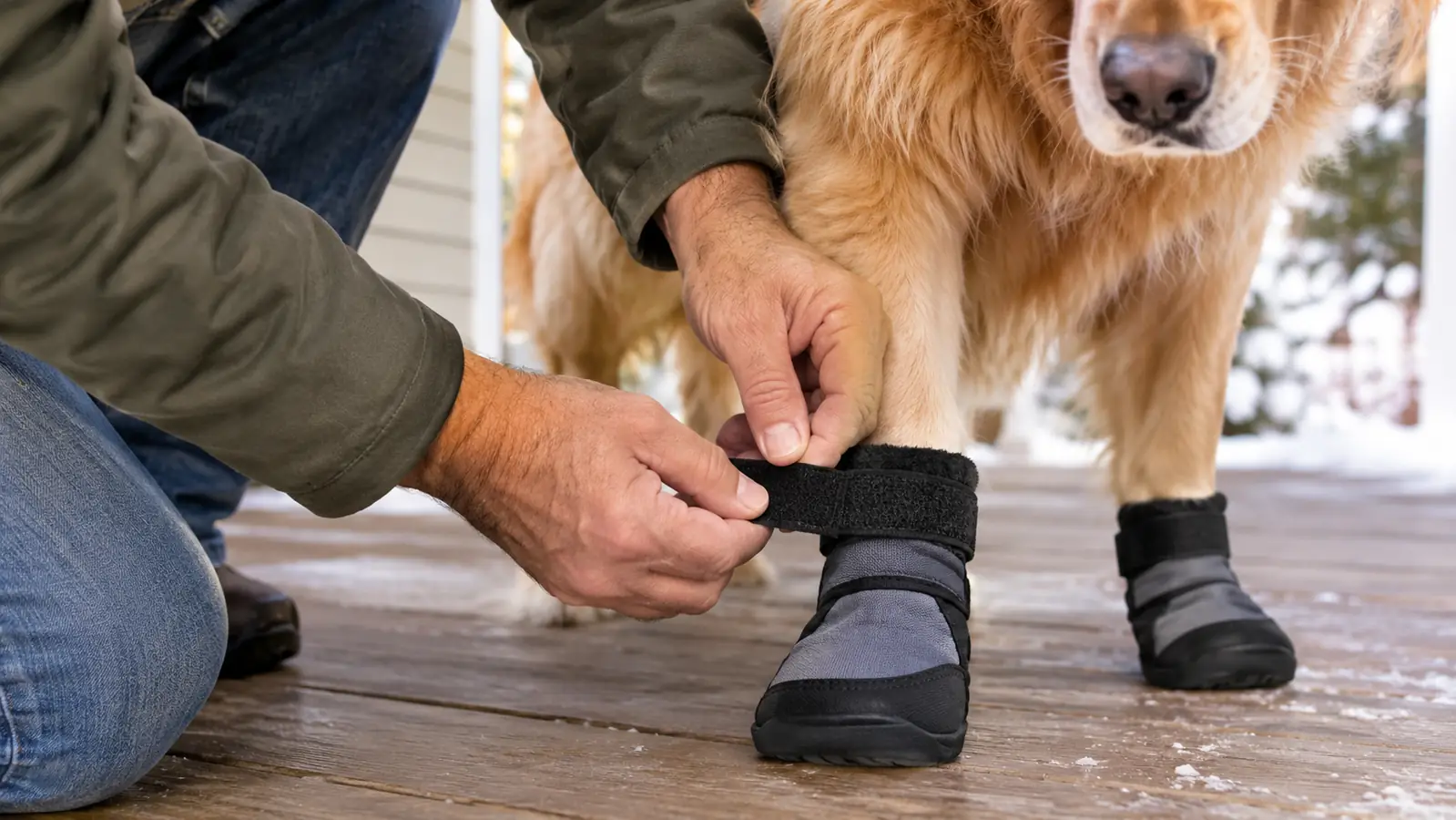
Each boot uses a hook and loop closure that wraps around the leg above the paw. For Pepper's skinny Min Pin legs, I pull the strap as snug as it will go, and it stays put for the whole walk. The sole is a slip-proof rubber with a bit of give, and the upper is a soft fabric that does not rub against her ankle. She still lifts her feet a little higher than normal for the first few steps, but she walks, and more importantly, she does not limp afterward. That was the whole point of buying them.
I have also learned when not to use them. On a dry day, the boots are overkill, and Pepper would rather feel the ground. On deep snow, the boots pack snow around the top and she stops to bite at the strap. They shine on the specific conditions that hurt her bare paws: ice, salt, cold wet pavement. Knowing that boundary has made the boots work better, because I reach for them at exactly the right moments.
What Nobody Tells You About Sizing
Here is what I wish someone had told me before I ordered: the size chart is about paw width, not dog weight. The listing says to measure the width of your dog's paws carefully, and that is not a suggestion. I measured Pepper's front paw, checked the size chart, then measured again because I did not believe the number. These boots are listed for large breed dogs, and the Size 7 boot measures about 2.8 by 3.2 inches. That is a big boot for a 10-pound dog, and no amount of hoping makes a big boot fit a little paw.
On Pepper, even the smallest size in the set is roomy. The boots stay on because of the straps, not because of the fit. I snug the hook and loop closures tight and the boot holds, but there is empty space inside around her toes. She does not seem to mind, and the boot does not slip, but I can feel the extra room when I put them on. If your dog is under about 8 pounds, or has very narrow paws, these will likely be too big no matter how tight you pull. That is the honest truth, and it is the number one reason people send these back.
The other thing nobody tells you: the boots are not shaped like a dog's paw. They are shaped like a small shoe, with a flat sole. That is fine on pavement and packed snow, where the ground is flat. On uneven ground, the boot can twist a little, and Pepper will stop and shake her foot until it settles. I have learned to keep our boot walks on flat, cleared surfaces, and on those surfaces the shoe shape is a non-issue.
Measure both front paws, by the way. Dogs are rarely perfectly symmetrical, and Pepper's front paws are a hair wider than her back paws. The set of four means all the boots are the same size, so I fit the boots to her front paws and the back paws are fine with the straps snugged a little tighter. If your dog has a big difference between front and back paws, that is worth knowing before you order.
What These Boots Do Well
Once the sizing is sorted, these boots do the job they are supposed to do. The slip-proof sole gives Pepper traction on ice in a way her bare pads never could. Before the boots, she walked with a careful, stilted step on the icy parts of the loop, stopping every few feet to lift a paw. With the boots, she trots. That alone was worth the purchase, and it is the reason I reach for them all winter.
The materials are solid for the price point. The listing describes a rugged sole with high quality fabrics sewn together, and after a full winter of use I would agree. The soles show normal wear but no separation. The fabric uppers have held their stitching through ice, salt and the occasional puddle. The faux leather trim has not cracked, and the silicone and rubber sole still grips. I hand wash them in the sink when they get grimy, and they come out looking close to new. The care instructions say hand wash only, and they mean it. These are not boots you can toss in the machine, but the hand washing is quick and they dry overnight.
The hook and loop closure is the detail that makes them work. It is easy to get on and off, even with a wiggly dog, and it adjusts enough to fit over Pepper's skinny ankles. I have tried other boots with zippers and snaps, and they were a battle every single time. The straps take about ten seconds per boot, and the set comes with a simple instruction manual that actually makes sense, which is rarer than it should be.
The set of four means I never have to think about which paw is protected. Some dogs only need front boots, but Pepper needs all four on a salted walk, and having the full set ready in the porch basket means I can get her dressed and out the door before she starts dancing with impatience. The boots are light, the whole package listed at about 7 ounces, so she does not seem weighed down by them.
Where They Fall Short
I have to be honest about the limits. The listing sells these as dog shoes for hot pavement, snow boots, and paw protectors, and that is a lot of jobs for one product. In my experience, they are best at the winter jobs: snow, ice, salt, cold wet pavement. I have not tested them on truly hot pavement because Pepper does not go out in the heat of the day, and I would not trust a faux leather and fabric boot to do much for a dog on a hot sidewalk anyway. Hot pavement needs a different solution.
The sizing is the biggest weakness, and it is a real one. These boots run large, and for toy and small breeds the smallest size is still roomy. If you have a dog under about 10 pounds, or a dog with narrow paws, measure very carefully and expect to rely on the straps. If you have a puppy that is still growing, hold off. Buying these for a puppy means buying again in a few months, and the hand wash only care gets old fast with a growing dog that finds every puddle.
The set of four is also the only option. You cannot buy a pair, or a single boot for a dog that favors one front paw. If you only need front boots, you still buy four. And the boots are not for all-day wear. Pepper wears them for 15 to 20 minute walks, and that is the right amount. I would not leave them on a dog for hours, especially indoors, where the boot traps heat and the dog cannot shake it off easily. Take them off when you get home.
The straps are the other thing to watch. They hold well on a normal walk, but if Pepper runs, the strap on the front left boot has worked loose a few times. I have learned to check the straps halfway through a longer walk and give them a tug if needed. It is a small thing, but it is the kind of detail that only shows up after you have used the boots for a while.
What I Liked
- Slip-proof rubber sole gives real traction on ice and packed snow
- Hook and loop straps are easy to put on and adjust, even on skinny legs
- Materials and stitching held up through a full winter of icy, salted walks
- Set of four covers all paws, with an instruction manual included
- Hand washing brings them back close to new
Where It Falls Short
- Sizing runs large, so the smallest size is still roomy on a toy breed
- Size chart is about paw width, not dog weight, and that is easy to miss
- Boots are shaped like small shoes, so they can twist on uneven ground
- Set of four only, no option to buy a pair
- Hand wash only, and straps can work loose on a running dog
The boots stay on because of the straps, not because of the fit, and that is the honest truth about sizing these for a toy dog.
A Week of Practice, Then Real Walks
If there is one piece of advice I would give, it is to treat the first week as training, not walking. Put the boots on indoors for five minutes at a time. Let the dog walk around the kitchen, then the living room, then the porch. Reward her with a treat when she walks normally. Pepper went from high-stepping like a parade horse to walking normally in about a week, and now she stands still when she sees me pick up the boots. She knows the boots mean we are going out, and she is willing to put up with them for that.
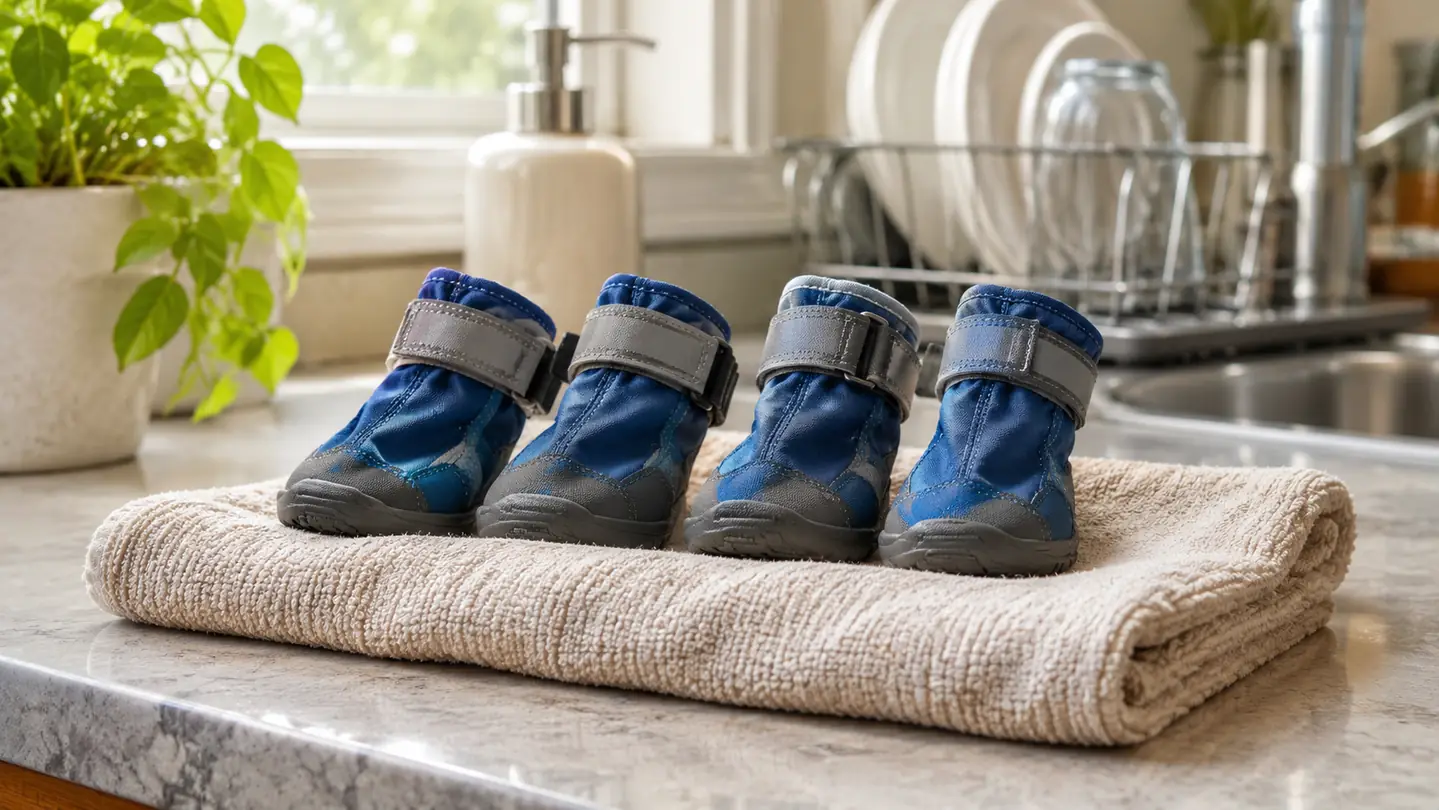
The other practical tip: dry them after every walk. The boots are hand wash only, but most days a quick wipe with a towel is enough to get the salt off. If they get properly muddy, I wash them in the sink with a little dish soap and let them air dry. They dry overnight on the counter, and they are ready for the morning walk. A little routine makes a big difference in how long they last, and it keeps the salt from eating at the stitching.
One more thing: check the inside of the boot before you put it on. A pebble or a bit of ice can get trapped in there, and a dog will not tell you, she will just walk funny and stop. I turn each boot inside out a little, give it a shake, and check the sole before every walk. It takes ten seconds and it has saved us from a few miserable walks.
Who This Is For
These QUMY boots are for owners of small to medium dogs who walk on ice, salt, or cold wet pavement in the winter and are tired of watching their dog lift its paws. They are also for anyone who has tried paw wax and found it does not last through a salted parking lot. If you have a dog in the 10 to 25 pound range with paws that measure close to the size chart, and you are willing to spend a week of short practice sessions, these will likely work well for you.
They are also for people who want a boot that is easy to put on. The hook and loop closure is genuinely simple, and the boots are not fussy about getting them on a moving target. If you have ever wrestled with a zippered boot on a dog that does not want to wear it, you will appreciate the straps.
Who Should Skip It
Skip these if you have a very small dog, under about 8 pounds, or a dog with unusually narrow paws, because the smallest size will still be loose. Skip them if you need boots for hot summer pavement, because I would not trust a fabric boot for that job. And skip them if you want a boot you can throw in the washing machine, because the hand wash only care is a real commitment. If your dog only needs front paw protection, the set of four is more than you need.
Skip them too if your dog refuses to walk in anything on her feet. Not every dog will adapt, and a week of practice is not a guarantee. Pepper took to them because she is a good sport and because the alternative was cold, salty paws. If your dog is more stubborn, or if you do not have the patience for a practice week, these boots will sit in the basket unused.
If your dog lifts its paws on icy walks, this is the fix
Measure the paw width first, order the set, and give your dog a week to get used to them. That is the whole honest formula.
Amazon Check Today's Price on Amazon →